
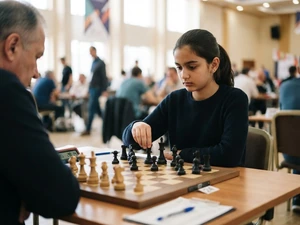
11-Year-Old Girl Breaks Chess Record That Stood for 38 Years
By Morgan Blake. Aug 3, 2026
An 11-Year-Old Beat a Reigning National Champion
Bodhana Sivanandan was 11 years and four months old when she defeated French grandmaster Marc’Andria Maurizzi at the Dole Trophy in France, breaking a girls’ age record that had stood since 1988. Maurizzi was not an aging former champion playing an exhibition. He was the reigning French champion, a former world under-20 champion and a player rated above 2600.
That distinction matters in chess. A grandmaster rating above 2600 belongs to a level occupied by a relatively small group of elite competitors. Sivanandan’s victory made her the youngest girl known to defeat a grandmaster of that strength and placed her among the youngest players of any gender to do it.
The Record Had Belonged to Judit Polgar
The previous benchmark belonged to Judit Polgar, widely regarded as the strongest female chess player in history. Polgar set the record in 1988, when she defeated a grandmaster rated above 2600 at age 12.
Sivanandan lowered that mark by roughly eight months. The comparison does not make her career equal to Polgar’s, but it shows the level of historical company attached to one tournament result. Polgar later reached the top 10 in the world rankings and defeated multiple world champions.
The Win Was More Than a Youth-Circuit Achievement
Youth records can sometimes depend on limited fields or age-group competition. This one did not. Sivanandan earned the result in open competition against an established adult grandmaster whose rating and credentials were independently verifiable.
The game also required more than one tactical surprise. Reports from the tournament described Sivanandan building and converting a winning position against a player accustomed to elite opposition. She lost her next game, then recovered with a draw against another grandmaster, Maxim Rodshtein, reinforcing that the record was not an isolated appearance against high-level competition.
Her Rise Has Been Building for Years
Sivanandan became one of British chess’s most closely watched young players well before this result. She has competed successfully against older opponents and has continued collecting the performance standards needed for higher international titles.
Her progress arrives during a period when online play, stronger youth coaching and easier access to elite games have accelerated the development of young competitors. None of those changes guarantees a player will defeat a national champion before finishing primary school. They only make it easier to understand how a rare talent can be tested earlier.
The Next Record Will Be Harder
One victory does not determine a chess career, and junior prodigies still face the difficult transition from exceptional youth player to consistent elite professional. Ratings rise more slowly as the opposition improves, and title requirements demand repeated performance rather than a single breakthrough.
Sivanandan has nevertheless cleared a benchmark that survived 38 years and belonged to one of the sport’s most important players. At 11, she has already produced a result that will follow every discussion of how early a chess player can compete with the world’s strongest adults.
References: The Guardian

The News Command team was assisted by generative AI technology in creating this content
Trending

Read More

Read More

Read More

Read More

Read More

Read More

Read More

Read More

Read More

Read More

Read More

Read More

Read More

Read More

Read More

Read More

Read More

Read More

Read More

Read More

Read More

Read More

Read More

Read More