Michigan Elects First Muslim U.S. Senator in History
By Taylor Brooks. Nov 11, 2026
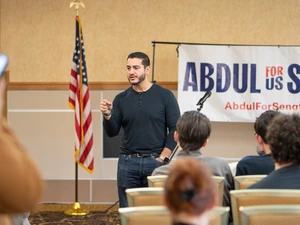
Caption: Abdul El-Sayed meets voters at Michigan Technological University in October 2025. Credit: Conlan Houston / CC BY-SA 4.0, via Wikimedia Commons.
Abdul El-Sayed won Michigan’s open U.S. Senate seat on November 3, becoming the first Muslim elected to the chamber in American history. The Democrat defeated former Republican Rep. Mike Rogers after a contentious campaign that drew national attention to his religion, political views and experience in public health.
El-Sayed is the son of Egyptian immigrants and trained as a physician. Before his Senate victory, he held senior public-health responsibilities and ran unsuccessfully for Michigan governor in the 2018 Democratic primary. That earlier defeat made his return to statewide electoral politics part of a personal political reversal as well as a first for the Senate.
From public health to elected office
According to Associated Press election reporting, El-Sayed had never held elective office before defeating Rogers. His prior experience involved directing public-health work, and he approached the campaign as a progressive whose political identity differed from some of Michigan’s more established Democratic figures.
The race took place in a state with a large and politically active Arab American and Muslim population, but his victory was statewide. Voters across Michigan chose between candidates with markedly different views of national policy and the current administration. El-Sayed’s result also helped his party retain a seat as Democrats gained the Senate majority nationally.
The campaign included heated disputes over El-Sayed’s faith and public positions. Republican critics linked his progressive views to broader attacks on the Democratic Party; he rejected those portrayals and emphasized his policy priorities. Associated Press reporting described it as a bruising contest, while the Guardian reported that some attacks on him involved anti-Muslim rhetoric.
In election-night remarks, El-Sayed acknowledged the significance of winning after a campaign in which his identity had been a focal point. His career history separates the story from a simple milestone: he had faced a major primary loss, built a national profile in health policy and returned to win one of the country’s closely watched federal races.
A milestone with immediate Senate consequences
The victory changes the composition of the Senate itself. Although Muslim Americans have served in the U.S. House of Representatives, the Senate had never before elected a Muslim member. El-Sayed will take the seat when the newly elected Congress begins in January 2027.
El-Sayed’s previous work directing Detroit’s health department put questions of medical access and public-health systems at the center of his career before he entered electoral politics. In the Senate, healthcare and federal spending will be among the policy debates affecting his home state.
The election marks his return to statewide politics eight years after an unsuccessful bid for governor. He will enter the Senate when the new Congress convenes in January 2027.
References: Progressive Democrat Abdul El-Sayed wins Michigan Senate race, will become first Muslim senator | Progressive Abdul El-Sayed wins Michigan Senate race to become first Muslim US senator

The News Command team was assisted by generative AI technology in creating this content
Trending





Read More

Read More

Read More
Read More



Read More

Read More