
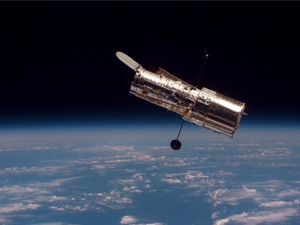
Hubble Telescope Marks 35 Years With Andromeda Mosaic
By Jordan Mercer. Dec 29, 2025
NASA marked the Hubble Space Telescope's 35th year in operation by
releasing a 2.5-gigapixel mosaic image of the Andromeda galaxy — the
largest, most detailed image of Andromeda ever produced by the
observatory, according to NASA's 2025 year-in-review report. The image
represents a milestone both in longevity and in continued scientific
output for a telescope that launched in April 1990.
Hubble, the first major optical telescope placed in space, transformed
astronomy within years of its launch. After a servicing mission
corrected an initial flaw in its primary mirror, it began producing
imagery and data that reshaped scientific understanding of the age of
the universe, the existence of supermassive black holes, and the
expansion rate of the cosmos.
35 Years of Continuous Operation
Hubble's 35-year operational history places it among the
longest-serving science instruments ever launched into orbit. Multiple
servicing missions carried out by Space Shuttle crews extended its
operational life well beyond original projections, replacing instruments
and upgrading components that kept the telescope competitive alongside
newer observatories, according to NASA.
The telescope now operates alongside NASA's James Webb Space Telescope,
which entered its third year of operations in 2025. The two instruments
are complementary rather than redundant — Hubble observes primarily in
ultraviolet and visible light, while Webb operates in infrared.
Together, they provide a combined view of the universe across a broader
range of wavelengths than either could achieve alone.
The Andromeda Mosaic
The 2.5-gigapixel Andromeda mosaic released in 2025 required assembling
hundreds of individual Hubble observations into a single composite image
of the galaxy nearest to the Milky Way. At the image's resolution,
individual stars within Andromeda are distinguishable — a level of
detail that illustrates both the scale of the galaxy and the resolving
power of the telescope after 35 years in operation.
NASA released the image as part of its broader acknowledgment of
Hubble's milestone year. The agency's 2025 highlights report cited it
alongside the completion of the Roman Space Telescope and Artemis II
preparations as part of what NASA described as "a new golden age of
exploration and innovation," per NASA.
References: Nasa Ignites New Golden Age Of Exploration Innovation In 2025 | Nasa Johnsons 2025 Milestones

The News Command team was assisted by generative AI technology in creating this content
Trending
Read More

Read More

Read More

Read More

Read More

Read More

Read More

Read More

Read More

Read More

Read More

Read More

Read More

Read More

Read More

Read More

Read More

Read More

Read More

Read More

Read More

Read More

Read More

Read More