
NASA Completes Roman Space Telescope for 2026 Launch
By Avery Collins. Dec 15, 2025
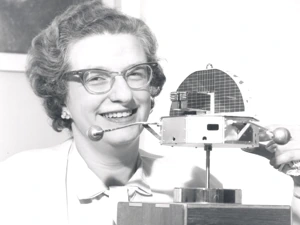
Dr. Nancy Grace Roman with Orbiting Solar Observatory model.

Glenn Research Center (GPN-2002-000212), public domain via
Wikimedia Commons
NASA completed construction and final assembly of the Nancy Grace Roman
Space Telescope in 2025, with the agency announcing that the observatory
is done and undergoing final testing ahead of a launch targeted for as
early as fall 2026, according to NASA's year-in-review report. The
telescope represents the agency's next flagship science observatory
following the James Webb Space Telescope, which entered its third year
of operations in 2025.
Named for Nancy Grace Roman — NASA's first Chief of Astronomy and the
"Mother of Hubble" — the telescope is designed to investigate some
of the most fundamental open questions in astrophysics, according to
NASA. Its primary science targets include dark energy, dark matter,
exoplanets, and the large-scale structure of the universe.
What the Roman Telescope Will Do
The Roman Space Telescope will conduct wide-field surveys of the sky at
infrared wavelengths — a capability that positions it as a complement
to rather than a replacement for the James Webb Space Telescope, which
excels at deep, targeted observations of individual objects. Roman's
strength lies in its ability to observe large regions of sky
simultaneously, producing a panoramic view of the cosmos that Webb's
narrower field cannot replicate, according to NASA.
One of Roman's primary science programs involves a microlensing survey
of the galactic core designed to detect thousands of exoplanets —
including free-floating planets not bound to any star. That survey alone
is expected to transform scientists' understanding of how planetary
systems form and distribute throughout the galaxy.
Part of NASA's Broader 2025 Milestone Year
The Roman telescope's completion came alongside a series of significant
NASA accomplishments in 2025. The agency landed two robotic science
missions on the Moon, advanced preparations for the Artemis II crewed
lunar flyby — the first crewed mission around the Moon in more than 50
years — and grew the Artemis Accords to 59 signatory nations,
according to NASA's Johnson Space Center 2025 milestone report.
James Webb, now in its third year of operations, continued producing
discoveries in 2025, including a 2.5-gigapixel Andromeda galaxy mosaic
released to mark Hubble's 35th year, per NASA. Roman's eventual launch
will add a third major space observatory to an already active era of
space-based astronomy.
References: Nasa Ignites New Golden Age Of Exploration Innovation In 2025 | Nasa Johnsons 2025 Milestones

The News Command team was assisted by generative AI technology in creating this content
Trending

Read More

Read More

Read More

Read More

Read More

Read More
Read More

Read More

Read More

Read More

Read More

Read More

Read More

Read More

Read More
Read More

Read More

Read More

Read More

Read More

Read More

Read More

Read More
Read More