
NASA Spots Life\'s Building Blocks Erupting From Interstellar Comet
By Morgan Blake. Feb 22, 2026

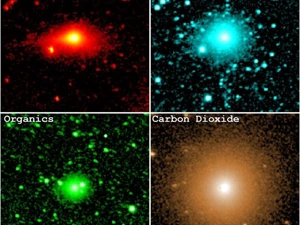
NASA's SPHEREx space telescope detected methanol, hydrogen cyanide,
methane, water vapor, and carbon dioxide erupting from Comet 3I/ATLAS
— only the third confirmed interstellar object ever detected passing
through our solar system and the first interstellar comet large enough
to exhibit a visible coma, according to LiveScience. The findings,
published in February 2026 in the Research Notes of the American
Astronomical Society, represent the first direct detection of organic
molecules in an object known to originate from outside our solar system.
Comet 3I/ATLAS was discovered in July 2025 as it approached the Sun on a
hyperbolic trajectory — a path so steep that it could only have
originated in interstellar space rather than from the Oort Cloud or
Kuiper Belt, the regions of our own solar system where comets typically
originate. Its classification as an interstellar object was confirmed
within days of discovery, making it the most significant interstellar
visitor detected since 'Oumuamua in 2017 and Comet 2I/Borisov in 2019,
per Universe Today.
What SPHEREx Detected
SPHEREx — the Spectro-Photometer for the History of the Universe,
Epoch of Reionization and Ices Explorer — observed Comet 3I/ATLAS in
December 2025 as it activated and began outgassing material from its
nucleus. The telescope's infrared spectroscopy capabilities allowed it
to identify specific molecular signatures in the comet's coma: the
cloud of gas and dust surrounding the nucleus that forms as solar
radiation heats the comet's surface.
The specific molecules detected — methanol, hydrogen cyanide, methane,
water vapor, and carbon dioxide — are among the basic organic
compounds that appear in star-forming regions throughout the galaxy and
that form the chemical precursors to amino acids and other complex
biological molecules, according to LiveScience. Their presence in an
interstellar object confirms that the chemistry capable of seeding life
is not unique to our solar system — it appears to be a product of the
galaxy-wide star and planet formation process.
The Third Interstellar Visitor
3I/ATLAS follows two previous confirmed interstellar objects:
'Oumuamua, detected in 2017 and notable for its unusual elongated shape
and unexplained acceleration, and Comet 2I/Borisov, detected in 2019,
which was the first confirmed interstellar comet and showed water ice
signatures consistent with comets in our own solar system. 3I/ATLAS is
by far the largest of the three and the first to show the kind of robust
outgassing activity that allowed SPHEREx to conduct detailed
spectroscopic analysis.
Universe Today noted that the comet's activation as it approached the
inner solar system gave astronomers a narrow but unprecedented
observational window. The combination of its interstellar origin and its
organic molecular inventory has prompted significant discussion among
astrobiologists about what the findings imply for the distribution of
life-building chemistry across the galaxy, per LiveScience.
Implications for Panspermia Science
The detection of organic molecules in 3I/ATLAS provides the strongest
direct evidence yet for the concept of interstellar panspermia — the
idea that the chemical precursors to life, or potentially life itself,
could travel between star systems via comets, asteroids, or interstellar
dust. While the 3I/ATLAS findings confirm only the presence of organic
chemistry rather than biology, they establish that the materials
required for life can survive interstellar transit in concentrations
detectable from Earth.
The New York Post cited scientists working on the findings who noted
that if 3I/ATLAS is representative of interstellar comets generally, the
galaxy may be continuously seeding star systems with organic chemistry
— a conclusion with profound implications for the probability of life
emerging in planetary systems throughout the Milky Way.
References: Nasa Telescope Spots The Building Blocks For Life Spewing Out Of Comet 3I Atlas | Interstellar Visitor 3Iatlas Finally Wakes Up Spewing Organics And Water | Atlas Organic Molecules Seeded Cosmos With Life Scientists

The News Command team was assisted by generative AI technology in creating this content
Trending

Read More

Read More

Read More

Read More

Read More

Read More

Read More

Read More

Read More

Read More

Read More

Read More
Read More

Read More

Read More

Read More

Read More

Read More

Read More

Read More

Read More

Read More

Read More

Read More