
Singapore Changi Named World's Best Airport for 2026
By Jordan Mercer. Feb 2, 2026

Singapore's Changi Airport retained its position as the world's best
airport in 2026, continuing a dominance of global airport rankings that
has made it the benchmark against which all other airports are
evaluated, according to The Aviation Hub. Hamad International Airport in
Doha, Qatar placed second, followed by Tokyo's Haneda Airport in third
— the same top three that have led most major airport quality rankings
for multiple consecutive years, per The Aviation Hub.
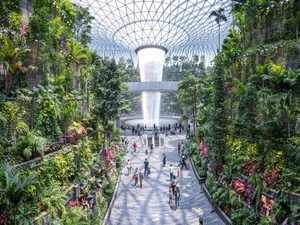
Changi's sustained first-place finish reflects a model of airport
development that most major airports are actively studying but few have
successfully replicated. The airport treats transit not as a logistical
inconvenience but as an amenity-rich experience — with a rooftop
swimming pool, indoor waterfall, butterfly garden, film screening rooms,
a slide connecting two terminals, and more than 280 food and retail
outlets spread across four terminals and the Jewel Changi mixed-use
complex, according to The Aviation Hub.
The Top 10 Airports Globally
The 2026 top 10, per The Aviation Hub's ranking of 50 major global
airports, placed the following in order: Singapore Changi (1), Hamad
International/Doha (2), Tokyo Haneda (3), Seoul Incheon (4), Tokyo
Narita (5), Munich (6), Zurich (7), Hong Kong International (8), Paris
Charles de Gaulle (9), and Dubai International (10).
North American airports appear later in the ranking. No U.S. airport
placed in the global top 20, a consistent pattern in airport quality
rankings that reflects the age and capacity constraints of America's
major hub airports — most of which were built in the mid-20th century
and have expanded incrementally rather than through comprehensive
redesign. The aviation infrastructure gap between the world's
top-ranked airports and the best-performing U.S. airports is one of the
most frequently cited structural challenges in American transportation
policy discussions.
What the Ranking Measures
The Aviation Hub's ranking evaluated airports across passenger
experience, on-time performance, connectivity (number of destinations
served), cleanliness, dining and retail quality, immigration and
security processing speed, and sustainable infrastructure investments.
Changi scored at or near the top across every category. Hamad
International's second-place finish reflects its extraordinary recent
investment in terminal expansion and passenger amenity infrastructure,
driven by Qatar Airways' status as one of the world's highest-rated
long-haul carriers.
Tokyo Haneda's third-place finish reflects Japan's broader cultural
emphasis on service quality and cleanliness — standards that translate
directly into the airport environment. Haneda's domestic terminal
operations, in particular, set benchmarks for on-time performance and
baggage handling that international terminals have been designed to
match.
The American Gap
The highest-ranked U.S. airports in the 2026 study — Seattle-Tacoma
International, Denver International, and Minneapolis-St. Paul
International — placed in the 25–35 range globally. LAX, Chicago
O'Hare, and New York's JFK airport — the country's busiest
international hubs — ranked in the bottom half of the 50-airport list,
dragged down by aging infrastructure, complex security processing, and
passenger experience scores that consistently underperform Asian and
European peers, per The Aviation Hub.
The gap is not primarily a function of funding — U.S. airports
collectively handle the world's largest volume of annual passengers and
generate substantial revenue. It is, rather, a function of the
incremental expansion model that has characterized American airport
development, which layers new construction onto legacy infrastructure
rather than redesigning from the ground up as Changi and Hamad have
done.
References: The Top 50 Airports In The World For 2026 | https://www.airports.org/

The News Command team was assisted by generative AI technology in creating this content
Trending
Read More

Read More

Read More

Read More

Read More

Read More

Read More

Read More

Read More

Read More

Read More

Read More
Read More

Read More

Read More

Read More

Read More

Read More

Read More

Read More

Read More
Read More

Read More

Read More