
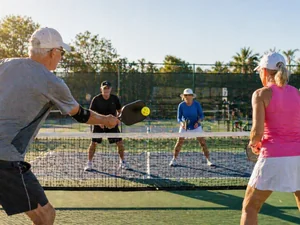
Adults Over 60 Now Lead Pickleball's Growth in America
By Taylor Brooks. Apr 15, 2026
A Sport That Found Its People
There’s a version of retirement that looks like slowing down. And then there’s what’s happening on pickleball courts across the country. According to data from the Sports & Fitness Industry Association, pickleball has grown more than 223% in participation from 2020 to 2024, making it the fastest-growing sport in the United States for three consecutive years. Adults over 60 make up the largest and most engaged demographic – a fact confirmed by USA Pickleball’s expanded 2026 National Championships structure, which added new Golden Ticket qualifying tournaments specifically to accommodate the surge in competitive senior participation.
This is not a trend that happened to older adults. They drove it.
Why Pickleball Works for This Stage of Life
The sport’s physical profile is a significant part of the appeal. Played on a court smaller than a tennis court, with a lightweight paddle and a perforated plastic ball, pickleball requires less running and produces less joint impact than tennis while still delivering cardiovascular benefit and demanding quick lateral movement and hand-eye coordination. Physical therapists have increasingly recommended it as a transition sport for patients returning to activity after surgery or injury, according to AARP reporting.
Research cited by AARP found that adults who played pickleball three times per week showed improvements in VO2 max – a key measure of cardiovascular fitness – of approximately 12% over six months. The sport also provides resistance benefits through paddle swings and lateral positioning that help maintain muscle mass, which declines naturally with age and affects long-term metabolic health.
The Social Dimension Nobody Predicted
What researchers and players alike have noted is that pickleball’s physical benefits may be secondary to its social ones. The sport is almost always played in doubles format, which means every session involves at least three other people. Courts tend to foster conversation between games. Local leagues and clubs have formed rapidly, and for many players – particularly those who relocated in retirement or whose social networks shrank during the pandemic – pickleball became a primary source of community.
Studies consistently show that social isolation is among the most significant health risks for older adults, comparable in impact to smoking or obesity. Pickleball, by its structure, works directly against that risk. USA Pickleball’s expansion of its senior tournament pathway in February 2026 reflects the institutional recognition of this dynamic – older adults are not just playing; they are competing, traveling, and organizing around the sport at a level that rivals any other demographic group.
What Active Aging Actually Looks Like
AARP Massachusetts noted in January 2026 that pickleball clinics designed for beginners 50 and older were filling quickly, drawing people who described themselves as former athletes and people who had not played a sport in decades. That range is part of what makes the data significant – this is not a story about already-active people staying active. It includes people who had stepped away from physical competition and found a re-entry point that fit where they are now.
For many readers, the pickleball boom offers a concrete, data-backed model of what active aging can look like – not a maintenance program, but a genuine athletic and social identity built in the second half of life. The court is smaller. The stakes are real. And it turns out that matters.
References: USA Pickleball Announces Expanded Path to Nationals for 2026 | Pickleball: The Sport That’s Changing the Game for Health and Community

The News Command team was assisted by generative AI technology in creating this content
Trending

Read More

Read More
Read More
Read More

Read More
Read More

Read More

Read More

Read More

Read More

Read More
Read More
Read More
Read More

Read More

Read More
Read More

Read More

Read More
Read More

Read More

Read More
Read More
Read More